


Renewed tensions between the U.S. and Iran, worries over Fed policy, and AI-related stock valuations are keeping investors up at night. Yet, equities keep grinding higher amidst these issues. Do investors have reason to be concerned? This week's musings are inspired by the 1984 movie "Gremlins". Here is some trivia about the movie:
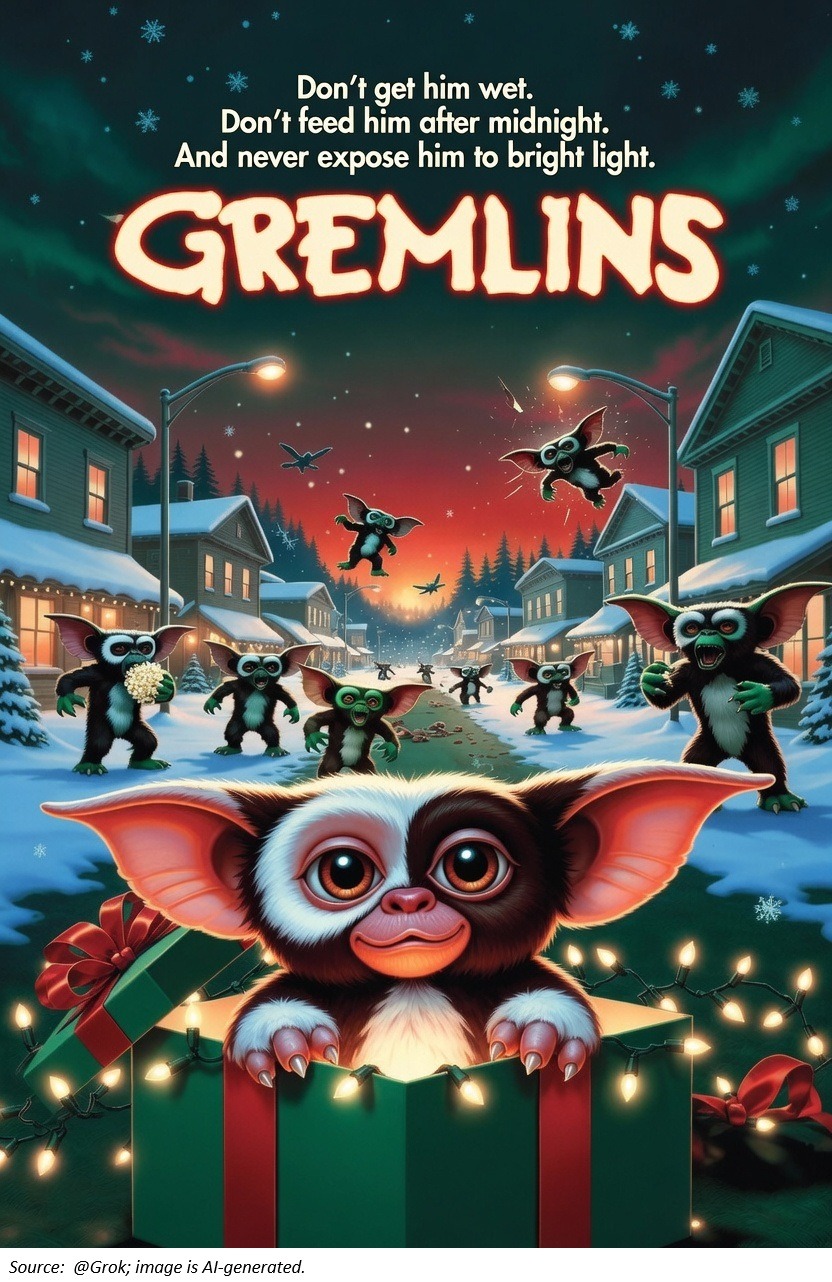
- This movie was a huge hit at the box office, which is no surprise given that it's a Spielberg production. The budget for the film was approximately $11 million, while the box office receipts exceeded $165 million. In fact, it was the 4th highest grossing movie in 1984. Spielberg had two films in the top 4 of the box office that year - this film and "Indiana Jones and the Temple of Doom."
- The main Gremlin, Gizmo, was originally going to be the same character as Stripe. The thought was for Gizmo to have an alter ego. Spielberg nixed the idea in favor of a good vs evil approach.
- The Cantonese name for Gizmo was "mogwai" in the film, which literally translated means "devil" or "demon."
- There was no CGI in the film, meaning that each of the Gremlins were animatronics, each costing between $30,000-40,000. Security during filming would check all individuals leaving the lot each day to make sure none were stolen.
- Spielberg initially considered Tim Burton as the director of the film, but decided against it because at the time Burton had not yet directed a full-length film.
- The studio set for this movie was the same one used for the town of Hill Valley in "Back to the Future."
Here's what we've seen so far this week...
Never Expose Them To Sunlight. One of the cardinal rules of keeping a gremlin/mogwai is to not expose them to sunlight or it will kill them. That's the quandary facing the Fed moving forward - hike rates and potentially stall the economy. According to Nick Timiraos, the so-called  "Fed Whisperer," the latest release of the June FOMC minutes reveals that "almost all" of the voting members see the need to raise rates if inflation pressures persist.1 And yet, "almost all" also believe they can hold rates steady if inflation moves lower soon.1 Well, the good news is that the latest inflation "Nowcast" for both June and July, according to the Cleveland Fed, express inflation dropping from +4.2% to +3.9% in June and +3.7% in July.2 If that's the case, there's little else to suggest a need for rate hikes. The labor market is stable, but not hot. GDP is stable, but also not hot. The Fed's stated mandates are "maximum employment, stable prices, and moderate long-term
  interest rates."3 Unless the Fed intends to deviate from those mandates, rate hikes should be off the table for now. The reality is that, while it's not always a certainty, most Fed rate hiking cycles have ended bull market runs because policy shifts tend to go too far. Director of the National Economic Council (NEC), Kevin Hassett, stated this week that the Fed raising rates would be a "macroeconomic mistake."4 According to Timiraos, there could be politics involved in the dissention on the FOMC Board.4 Regardless, since 1965, there have been 12 distinct Fed rate-hiking cycles. At least nine of them coincided with bear markets (20%+ declines) and at least 8 led to recessions.5 It would appear, given the current economic environment, that Mr. Hassett could be correct that a rate hike would be ill-advised.
Don't Get Them Wet. The 2nd rule when owning a gremlin is to not get them wet or they will multiply. That's exactly what has happened since the AI story has come under some scrutiny. Currently, more than 66% of S&P 500 stocks are trading above their respective 200-day  moving averages, indicating improved breadth in the market.6 The Mag 7 and AI-related stocks have come under pressure due to a shift in how AI is perceived moving forward. According to Morgan Stanley, AI-related companies are now going to be judged by excess computing capacity and the ability to actually generate revenue.7 This may make the road ahead tougher for AI-related stocks, while stocks in other sectors have exceeded expectations. Over the last 3 months, somewhat forgotten sectors like Financials, Healthcare, and Industrials are up
  more than 6%.8 Meanwhile, labor markets continue to show resiliency and do not show any widespread multiplying of job losses. The latest readings on Initial Jobless Claims and Continued Claims show that the labor market is not at a point similar to previous pre-recessionary periods. Initial Claims for the week came in at 215,000, which is much lower than previous pre-recession spikes of more than 300,000 claims.9 Similarly, Continued claims were lower than expected this week at 1.8 million versus prior spikes of 2.5 million or more.10 If the job market is stable at full employment, the need to hike rates, at least according to their mandate, should be minimal.
Don't Feed Them After Midnight. The final rule in owning a gremlin is to not let them eat after midnight or they will turn into their evil alter ego. Investors sometimes miss out on opportunities in the market either because of bad information or just a misunderstanding of the  market. Their alter ego keeps them from solid investment returns. A survey conducted by Gallup indicates that at least 43% of respondents felt investing in stocks is a bad idea.11 Whether those respondents would rather spend the money on something material they desire or they are just afraid of the market, the assumption and bias is misplaced. Of course, some of the survey respondents over time have been influenced by short-term fluctuations in the market. However, therein lies the rub - investors need to understand what real rates of return are in order to properly allocate their portfolios over the long-term. The recent increase in inflation relative to the performance of various asset classes might be of interest to those who don't think investing in stocks is a good idea. Inflation, as measured by the Consumer Price Index started the year at 2.4% in January and increased to 4.2% in May.12 While that increase is largely due to
  geopolitical shocks causing oil to increase in March and April, prices increased all the same. If an investor was holding only cash or T-bills over that same time period, their real return (Asset Return minus Inflation), would be -2.7%. Bonds would have also yielded a negative return, only a little worse. Gold would have fared better, but the real return would have only reached +1.1%. Conversely, stocks would have provided a return of +6.5% over the level of inflation. Owning stocks over the long term has provided a strong hedge against the effects of rising inflation versus cash, gold, or bonds. By utilizing a financial professional, investors could come away with a better knowledge base and avoid investing pitfalls.
Click here to see the rules for Gremlins scene.....
https://x.com/nicktimiraos/status/2074924139073118340?s=12&t=rL12aWyiinzSgh3poyqO0w
https://x.com/nicktimiraos/status/2072386756469473686?s=12&t=rL12aWyiinzSgh3poyqO0w
https://x.com/nicktimiraos/status/2072386756469473686?s=12&t=rL12aWyiinzSgh3poyqO0w
https://x.com/rickyho_1989/status/2074405318348382578?s=12&t=rL12aWyiinzSgh3poyqO0w
Continued Claims (Insured Unemployment) (CCSA) | FRED | St. Louis Fed
__________________________________________________________________________________________________________________________________________
Disclosures
The information contained herein is for informational purposes only and is developed from sources believed to be providing accurate information. The opinions expressed are those of the author, are for general information, and should not be considered a solicitation for the purchase or sale of any security. The decision to review or consider the purchase or sell of any security should not be undertaken without consideration of your personal financial information, investment objectives and risk tolerance with your financial professional.
Forecasts or forward-looking statements are based on assumptions, may not materialize, and are subject to revision without notice.
Any market indexes discussed are unmanaged, and generally, considered representative of their respective markets. Index performance is not indicative of the past performance of a particular investment. Indexes do not incur management fees, costs, and expenses. Individuals cannot directly invest in unmanaged indexes. The S&P 500 Composite Index is an unmanaged group of securities that are considered to be representative of the stock market in general.
Past Performance does not guarantee future results.