


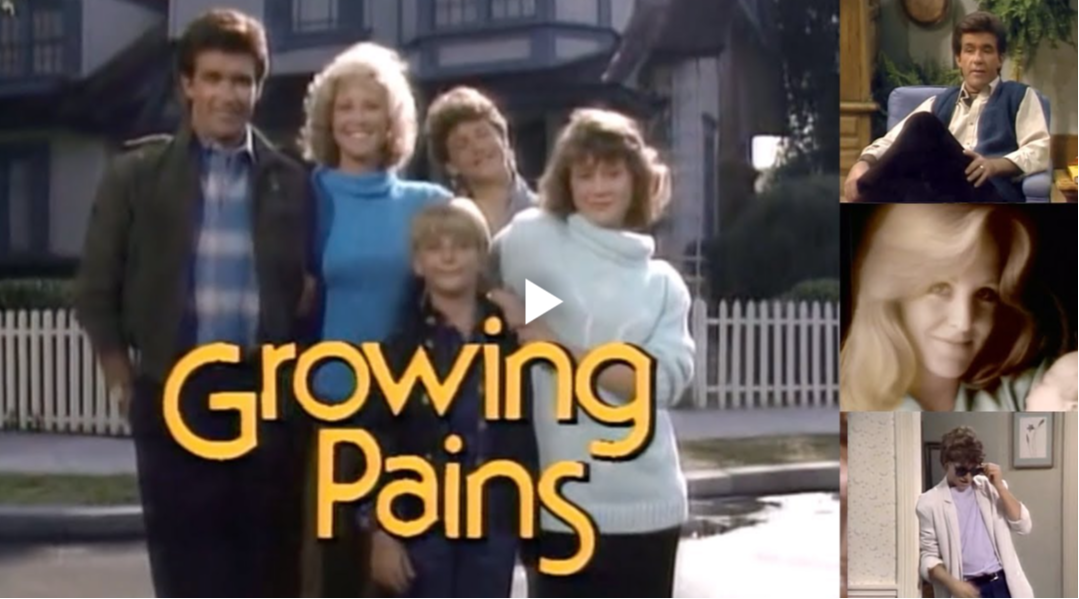
As investors, we have to go through multiple market cycles before we learn how to invest without passion and without prejudice. Much like going through adolescence, investors often have to learn some painful lessons as they mature into market afficionados. The inspiration for this week’s musings is the hit TV show “Growing Pains.” Here’s some trivia about  the show:
- The show ran on television from 1985 until 1992. It won two Emmys – the first in the show’s 2nd season and the other in the show’s next to last season. It was also nominated for 22 other Emmy Awards that were unsuccessful. The show peaked in its 2nd season ranking as high as #5 in the Nielsen ratings.
- Several famous actors got their start in episodes of “Growing Pains.” Brad Pitt appears in a few episodes – one as Carol’s love interest. Matthew Perry starred in 3 episodes as Carol’s boyfriend. Other notable young actors who appeared on the show were Heather Graham, Candace Cameron (Kirk’s sister), Will Wheaton, & Christina Applegate. The most famous was perhaps when Leo DiCaprio was added to the cast as a regular in the final two seasons of the show in an attempt to increase ratings.
- Some casting trivia provides insight into how different the show would have looked if other actors had been hired. The role of the dad, Dr. Jason Seaver, was once offered to Bruce Willis before Alan Thicke was awarded the role. River Phoenix was considered for the role of younger brother Ben Seaver. Little know actress Elizabeth Ward beat out Tracey Gold for the role of Carol Seaver, but Ward tested so poorly with audiences after the pilot, producers asked Gold to read for the part again.
- Like teenagers who learn through growing up, the TV show had to endure it’s share of “growing pains.” Tracey Gold suffered from eating disorders during the last 3 seasons of the show. Her absence in many episodes of the final season was explained in the show’s plot, but she did return for the finale. Kirk Cameron famously converted to Christianity during the height of the show, which caused tension between Cameron and the other cast members as he tried to influence the show – even leading to the removal of recurring guest actors. Cameron has since apologized for how he treated cast members during that period.
- The series finale aired in an hour-long special on April 25, 1992. Two other veteran shows of the ‘80s also aired their series finales on that same night – “Who’s The Boss” and “MacGyver.” No doubt those two shows will get their appearance in the musings if I have anything to say about it.
Here's what we've seen so far this week..
Geopolitical Noise? The past couple of weeks have been interesting from a geopolitical standpoint. Tensions arose over Iran's enrichment of uranium,  rockets were exchanged between Iran & Israel, then, ultimately, the U.S. gets involved by knocking out key uranium enrichment sites. If that were not enough, continued rocket fire exchanged between Israel & Iran after President Trump declared a temporary truce caused further conflict. In all, the damage to markets has been minimal. While Oil spiked on June 12th at the beginning of the conflict, it has come back down to where is was on June 11th. In the same breath, the S&P 500 Index is up 1% since June 11th as markets largely absorbed the geopolitical shocks. For the most part, the reason
  Oil retreated to normal levels was due to no lack of supply. All eyes were on the Strait of Hormuz, especially after Iran threatened to close the Strait. Nearly 20% of the world's oil travels through the Strait. As of this writing, traffic through the Strait has remained normal. Yet, even if Iran attempted to close the Strait, it is highly unlikely the nation would be successful. More than 70% of the oil traveling through the Strait goes to Asia, with nearly 40% going to China alone. There is an international coalition that would counter any attempt by Iran to close the Strait. And, finally, any closure attempt would also hurt Iran, as the country relies on oil imports and exports. Closing the Strait would devastate the Iranian economy. Just a cursory review of any of these facts would help the mature investor stay away from making hasty decisions in the market due to a few headlines.
Growing Pains At The Fed? Things are getting interesting at the Fed. As we noted last week, 8 members of the FOMC believe that two cuts in 2025  are appropriate, as evidenced by the Fed's own Dot-plot released last week. In addition, it would appear that some members are changing their opinions and deviating from Fed Chairman Powell. FOMC members Bowman, Waller, & Goolsbee have been hawkish for quite some time. And yet, in recent comments made late last week and this week indicate they believe the time is now to cut the Fed Funds rate. In fact, Fed Funds Futures have moved higher from only a 47% probability of a rate cut in September one month ago to a 68% probability today. One-month T-bills have moved over the last month from
  4.36% on May 23 to 4.21% as of June 25th. If you're wondering if there has ever been an attempted FOMC dilemma in voting, just reference the last time a Fed Chairman (Volcker) lost the room in 1986. Meanwhile, Chairman Powell's statements are starting to sound more ridiculous by the minute. This week, Powell stated, "If not for the expectations of higher inflation this year from tariffs, we would have continued cutting." This is nonsensical for a couple of reasons. First, the Fed stopped cutting in December of last year, four months before any change in tariff policy by the White House. Is Powell saying he foresaw what Trump would do and foresees tariff-related inflation (which has not yet materialized) and that's why the Fed stopped cutting rates? If so, it doesn't match up with his statement this week. Second, CPI sits at 2.4% on a year-over-year basis. That's exactly where it was when the Fed cut rates by 50 bps the first time. Inflation moved slightly higher as the Fed cut two more times by 25 bps, and that was before any change in tariffs. And yet, inflation has dropped back down to exactly where it was when the Fed cut by 50 bps in September of last year. If inflation is the same now as it was then, why is it so inappropriate to cut rates now?
Investing Growing Pains. Part of the growing pains for investors is learning not to rely on short-term data in making long-term investing decisions.  That's no more prevalent than right now. The latest investor surveys have shown wild expectations for inflation moving forward (some even 2x the current rate of inflation levels). However, business owners, as surveyed by the Atlanta Fed have much more tempered expectations, likely not swayed by emotions or politics. The year ahead expectations for inflation are 2.4% among business owners -
  coincidentally, exactly where inflation is measured today. Investors do, however, need to be cognizant of inflation and how it will affect their retirement. The median family income has risen over the past few years and currently stands at over $100,000 annually. However, when looking at inflation, which has grown over the same time period to reduce income by approximately $60,000 and the median home price has exploded to more than $426,000, the ability to stay ahead has diminished. But, when invested in equities at the same amount as annual income, the growth rate is exponentially higher. Median Family Income in 1963 was $6,249. That same amount invested in the S&P 500 Index would be worth more than $2.5 million today. Each investor must determine the appropriate amount of equity exposure in their respective portfolio based on risk tolerance and time horizon, but it's safe to say that not owning any equities could be detrimental to retirement and result in a typical consumer being priced out of life.
The theme to one of the hottest shows on TV in the '80s...
___________________________________________________________________________________________________________________
Disclosures
The information contained herein is for informational purposes only and is developed from sources believed to be providing accurate information. The opinions expressed are those of the author, are for general information, and should not be considered a solicitation for the purchase or sale of any security. The decision to review or consider the purchase or sell of any security should not be undertaken without consideration of your personal financial information, investment objectives and risk tolerance with your financial professional.
Forecasts or forward-looking statements are based on assumptions, may not materialize, and are subject to revision without notice.
Any market indexes discussed are unmanaged, and generally, considered representative of their respective markets. Index performance is not indicative of the past performance of a particular investment. Indexes do not incur management fees, costs, and expenses. Individuals cannot directly invest in unmanaged indexes. The S&P 500 Composite Index is an unmanaged group of securities that are considered to be representative of the stock market in general.
Past Performance does not guarantee future results.