


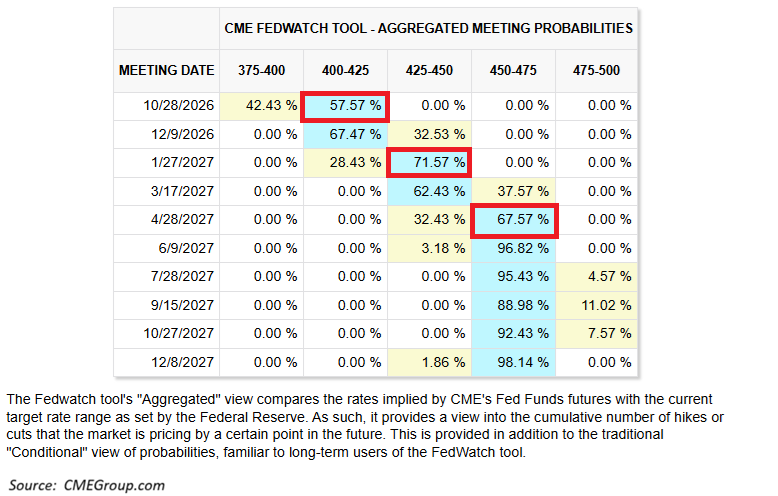
The Fed not only raised interest rates, but also signaled future rate hikes. The market had largely priced in a 25 basis point rate hike by the Fed on Wednesday. What the market did not expect was the Fed's own Dot-plot that indicated a 2nd rate hike in 2026 and at least one rate hike in 2027, as equities went from positive to negative with the reveal on Wednesday.1 The market is now pricing in more hikes as Fed futures are suggesting three more rate hikes - one in 2026 and two in 2027.2 So, if the market is pricing in a total of 4 rate hikes in 8 months, is that considered "fast" or "slow"? According to Liz Ann Sonders and Kevin Gordon at Schwab, a "fast" rate hiking cycle would be akin to the Fed hiking at every single meeting.3 However, as beauty is in the eye of the beholder, a fast, aggressive Fed might be in the eye of the investor. Will a market that has not seen rate hikes in over 3 years consider 4 hikes in 8 months "fast"? Time will tell.
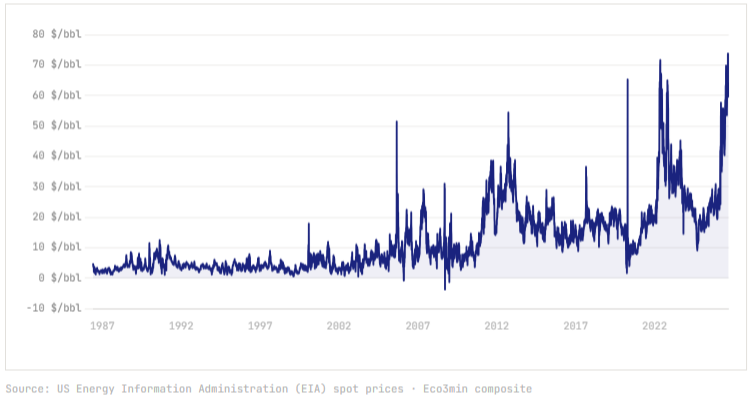
Markets are still grappling with daily headlines on the Middle East and oil remains elevated. Oil reached a 3-month high of $102/barrel last week, but ultimately fell back below $98/barrel.4 Over the weekend, Iran submitted conditions for ending the war with the U.S., but the U.S. has yet to respond.5 As of this morning, oil is trading lower, but we've been here before. The price of diesel fuel continues to move higher as Exxon Mobil's Joliet, Illinois fuel refinery, a major Midwest diesel supplier, was taken offline last week due to floodwaters overwhelming the pumps.6 Until the conflict sees some sort of resolution and oil exports from the Middle East near pre-war levels of 24 million barrels/day, consumers and investors alike could expect oil prices to stay elevated. This could exert more pressure on inflation and the Fed.
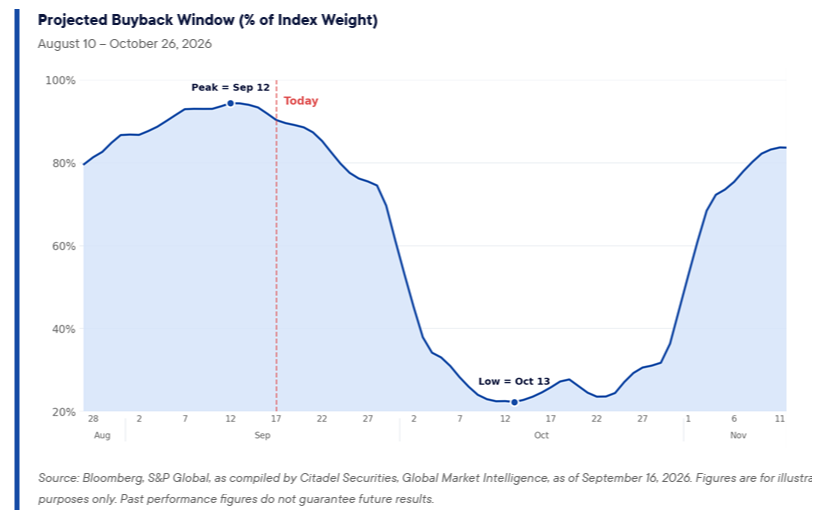
Another issue worth watching is revenue growth versus debt for AI-related companies. According to Fitch, default rates for private credit, the debt instruments that have been used to fund a large portion of the AI buildout, have moved higher, reaching 6.3%.7 In addition, AI companies may be overstating capital expenditures as the expense timing gap is sitting on balance sheets and will be charged later.8 Should that capex be fully expensed today, and also due to the nature of concentration of AI companies at the top of the index, the S&P 500 earnings per share could be meaningfully lower.9 Lastly, we are entering the season when corporate buybacks of equities have reached their blackout period at a time when market volatility could be precarious as we enter third-quarter earnings season and mid-term elections uncertainty. A review of relative risk tolerance and portfolio positioning on the part of investors at this point in time would not necessarily be a bad thing.
Sources / footnotes
- Federal Reserve FOMC projections (2026-09-16)
- FedWatch - CME Group
- Take a Hike: Rate Hikes and Market Impacts
- $WTIC | SharpCharts | StockCharts.com
- Iran submits conditions for ending war with U.S.
- Reuters: Exxon Mobil Joliet refinery floodwaters
- Bloomberg / Fitch: private credit default rate 6.3%
- TFTC: AI capex depreciation risk and S&P 500 earnings
- Mike Zaccardi on X
_________________________________________________________________________________________
Disclosures
The information contained herein is for informational purposes only and is developed from sources believed to be providing accurate information. The opinions expressed are those of the author, are for general information, and should not be considered a solicitation for the purchase or sale of any security. The decision to review or consider the purchase or sell of any security should not be undertaken without consideration of your personal financial information, investment objectives and risk tolerance with your financial professional.
Forecasts or forward-looking statements are based on assumptions, may not materialize, and are subject to revision without notice.
Any market indexes discussed are unmanaged, and generally, considered representative of their respective markets. Index performance is not indicative of the past performance of a particular investment. Indexes do not incur management fees, costs, and expenses. Individuals cannot directly invest in unmanaged indexes. The S&P 500 Composite Index is an unmanaged group of securities that are considered to be representative of the stock market in general.
Past Performance does not guarantee future results.