


As if questions surrounding AI and inflation were not enough, internal drama at one of the leading AI companies affected equity markets this week. Investors need to be aware of their own internal biases as markets have marched higher for four years since the October 13th bottom in 2022. This week we gather inspiration from the 1985 hit song "Money For Nothing" by Dire Straits. Here is some trivia about the song:

- This song hit #1 on the Billboard charts in 1985, won a Grammy for Best Rock Performance by a Duo or Group, was nominated for Record of the Year, and sold more than 3 million copies worldwide.
- Sting was a co-writer on this song with Mark Knopfler of Dire Straits. Knopfler overheard delivery men delivery men from a New York department store complain about their jobs. Many of the lyrics were things the workers actually said.
- Sting also provided some vocals for the song. In fact, Sting is the person singing the lines at the beginning of the song, "I want my MTV." Sting did not was songwriting credit, but his record company at the time, A&M, demanded it because they would earn royalties from the song.
- The innovative music video was one of the first to feature computer generated animation, which was done using an early program called Paintbox. It won Best Video at the 1986 MTV Music Awards.
- The video was directed by Steve Barron who also directed the famous A-Ha video "Take On Me" and Thomas Dolby's "She Blinded Me With Science."
Here's what we've seen so far this week...
Your Chips For Free? AI-related stocks have been having a rough go of it lately compared to other sectors of the market and certainly didn't need any bad news to exacerbate its struggles. This week it was revealed that Nvidia CEO Jensen Huang had an affair with a potential foreign spy and then it was reported that there were potentially other affairs within the company and national
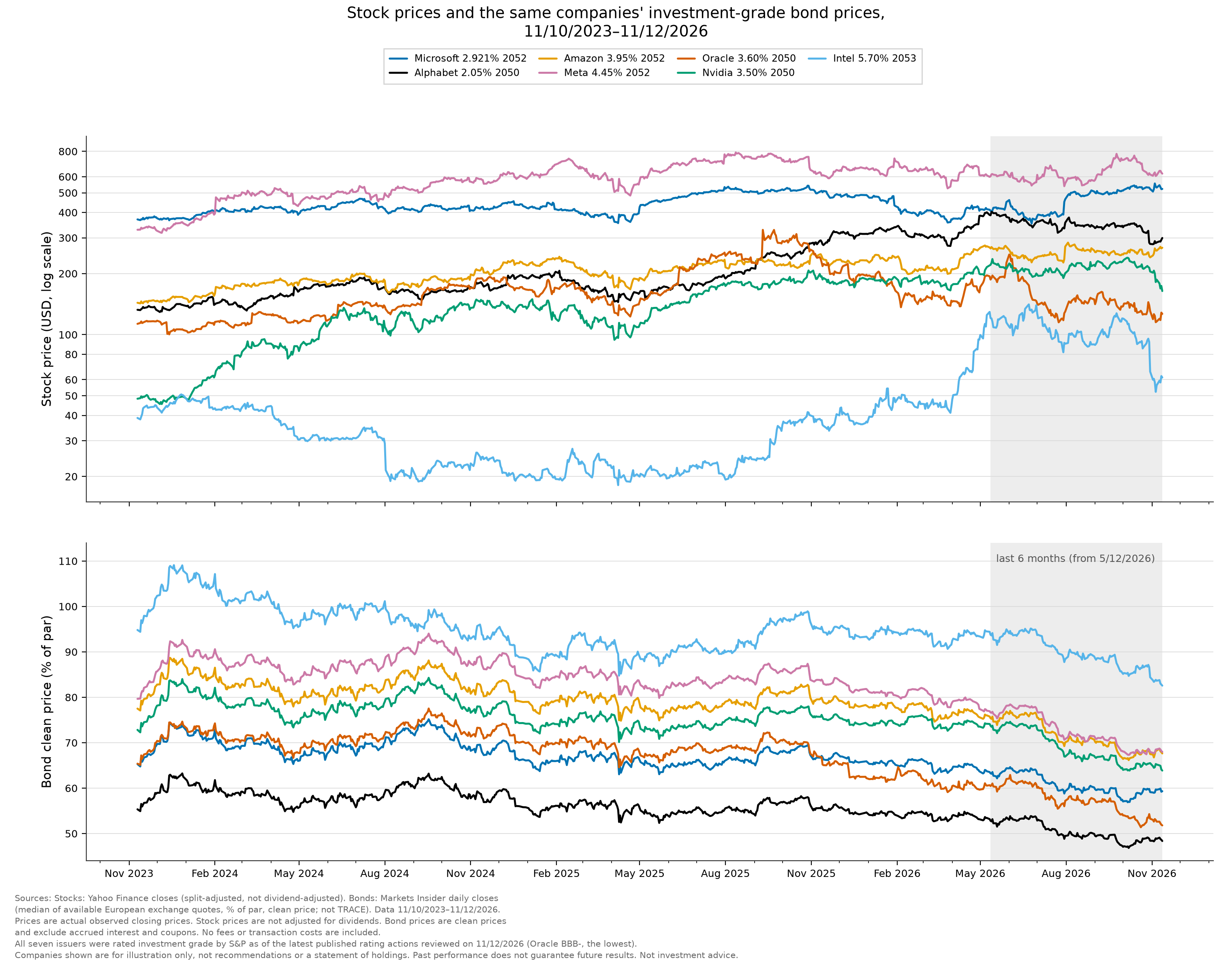
security implications.1 He has since stepped down as CEO. This event raises questions about the company's long-term growth prospects now that the firm's visionary is no longer there.1 AI-related companies had already been under some scrutiny and there emerged a disconnect between equity and fixed income markets. In June of this year, as evidenced in the graph above, bond prices of some of the more notable AI-related companies were falling as those came companies stocks were rising. The last couple of weeks spread between AI-related stock and bond prices has declined as those stocks have come under pressure.
Meanwhile, other areas of the equity market are holding up better than AI-related stocks. Over the last six months, as evidenced by the graph below, non-AI stocks from the S&P 500 Index have out-paced AI-related stocks on average. The excitement among investors that helped fuel AI-related stocks to the top of the market may have waned in light of revenue and demand questions. The
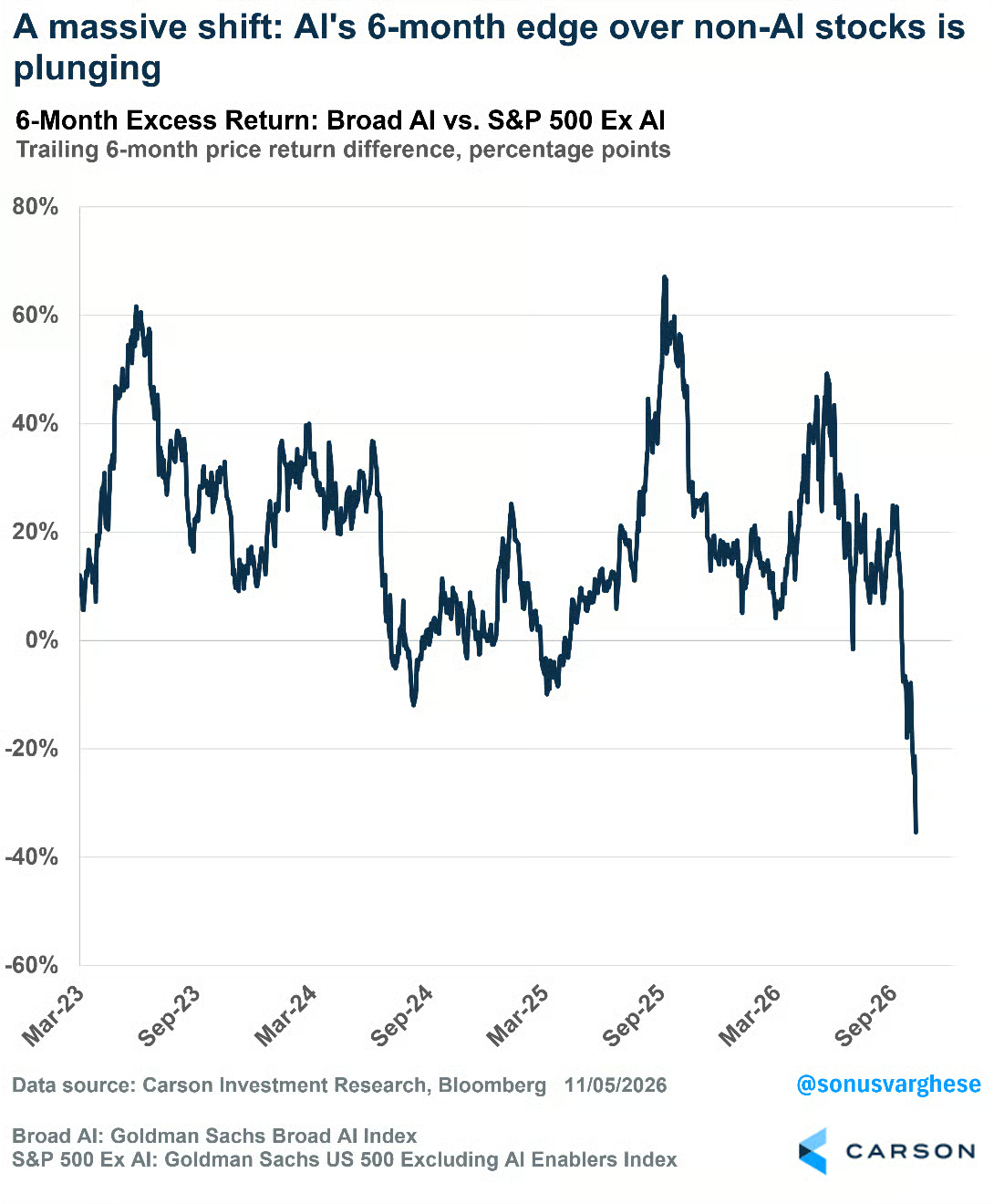
engine behind AI - GPU chips - is typically depreciated over a 3-6 year period.2 The actual useful life of a GPU has declined as AI models are more in use and prior versions of chips have become obsolete. This is raising questions about capital expenditures on AI chips. A longer depreciation schedule spreads out the costs, which lifts reported profit. In addition, Sam Altman, CEO of OpenAI warned Samsung executives, "There has been double-counting of demand" for AI which could lead to a "supply shock and an unsettled period."3 While the long-term usefulness of AI is not necessarily in question, the short-term prospects for AI could present problems for AI-related stock valuations.
Money For Nothing. On the economic front, it is looking more and more like the Fed is digging its heels in on fighting inflation and raising interest rates. The days of "free money" or loose financial constraints by the Fed may be a thing of the past for the foreseeable future. This week, the Consumer Price Index was higher than expected at +0.4% for October versus +0.3% expected.4 There
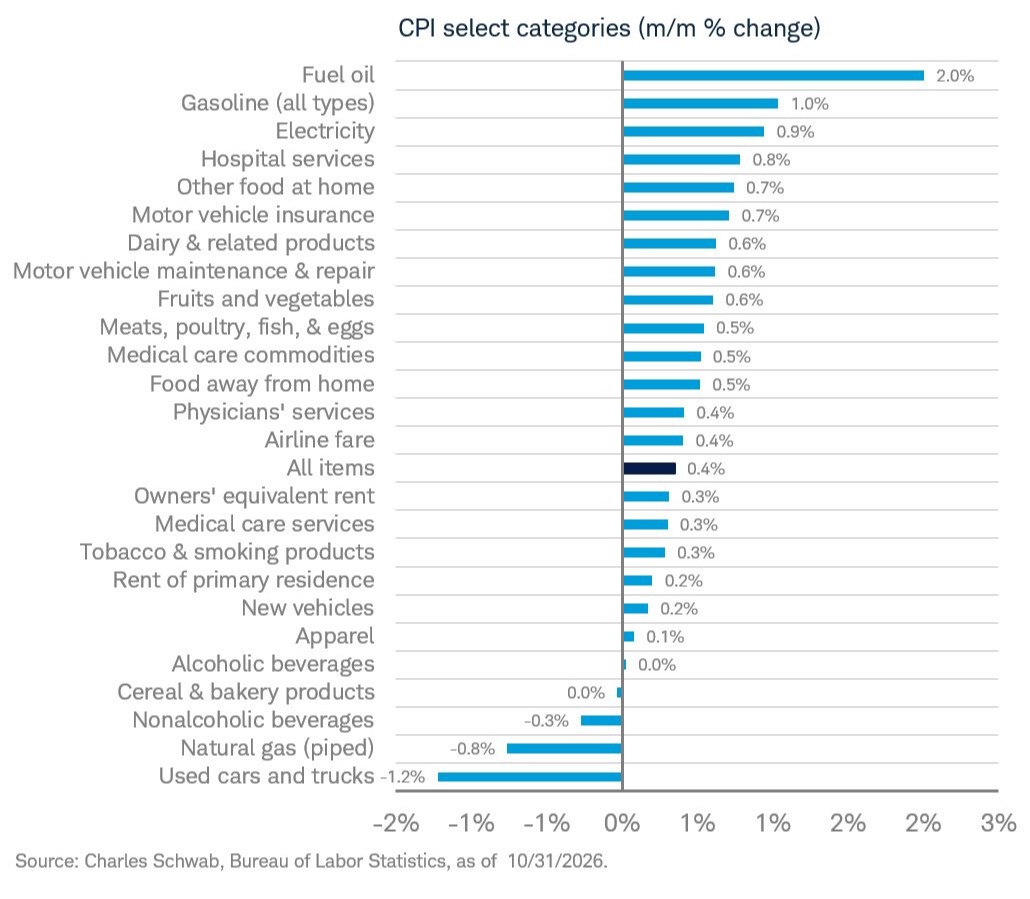
was no October 2025 report, so the year-over-year number for last month was not reported. Oil, the usual culprit lately, was the primary contributor to higher inflation. This drove the Fed Funds futures higher to at least an 85% probability of a 25 basis point rate hike next month.5 In fact, for the first time in over a month, there is now a 15% probability of a 50 basis point rate hike in December. Fed Governor Waller indicated that he would be willing to support a 50 basis point hike6 should Core CPI come in at +0.3% or higher - which, in fact, it did.7
Mortgage rates continue to hover around 3-year highs and another rate hike would be negative news for an already struggling housing market.8 If we add to that the situation among AI-related companies and their debt issues, higher rates would likely be unwelcome news. Lenders, as evidenced in the graph, are now charging a premium to AI-related companies that is not so prevalent
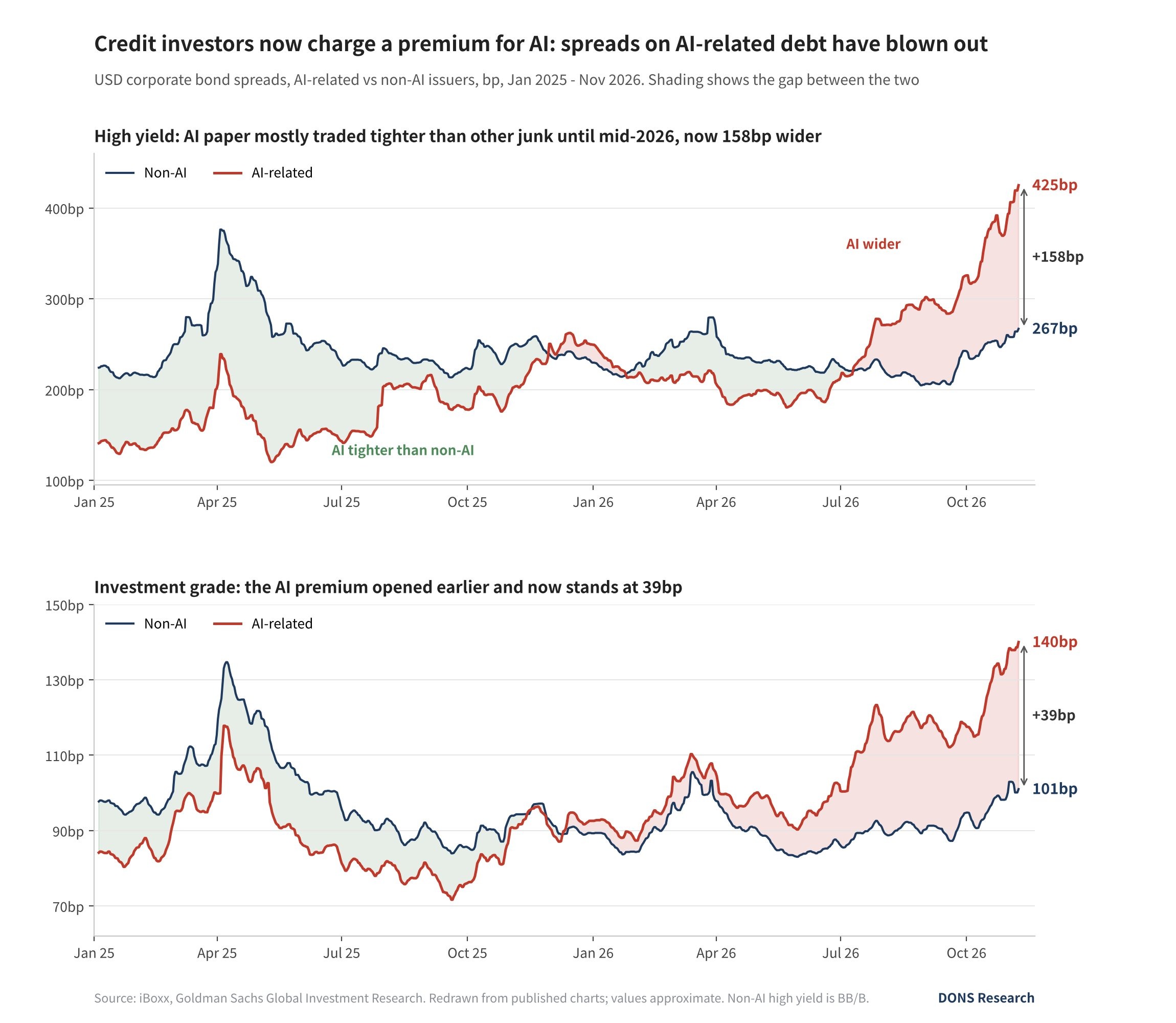
among non-AI companies. The spread between rates for high yield and investment grade debt between AI and non-AI companies is greater than 100 basis points. Another rate hike could put pressure on lenders to AI-related companies to increase premiums further. Given the questions surrounding AI and the controversy with Nvidia, the timing of rate hikes is certainly not ideal.
Custom Deliveries? One of the themes of the song "Money For Nothing" is the excesses of rock and roll and consumerism. The U.S. consumer has certainly been resilient over the past three years. Redbook Sales on a year-over-year basis have averaged over 8% this year, which is nearly double the long-term historical average of 4.4%.9 But, is the U.S. consumer taking on too much
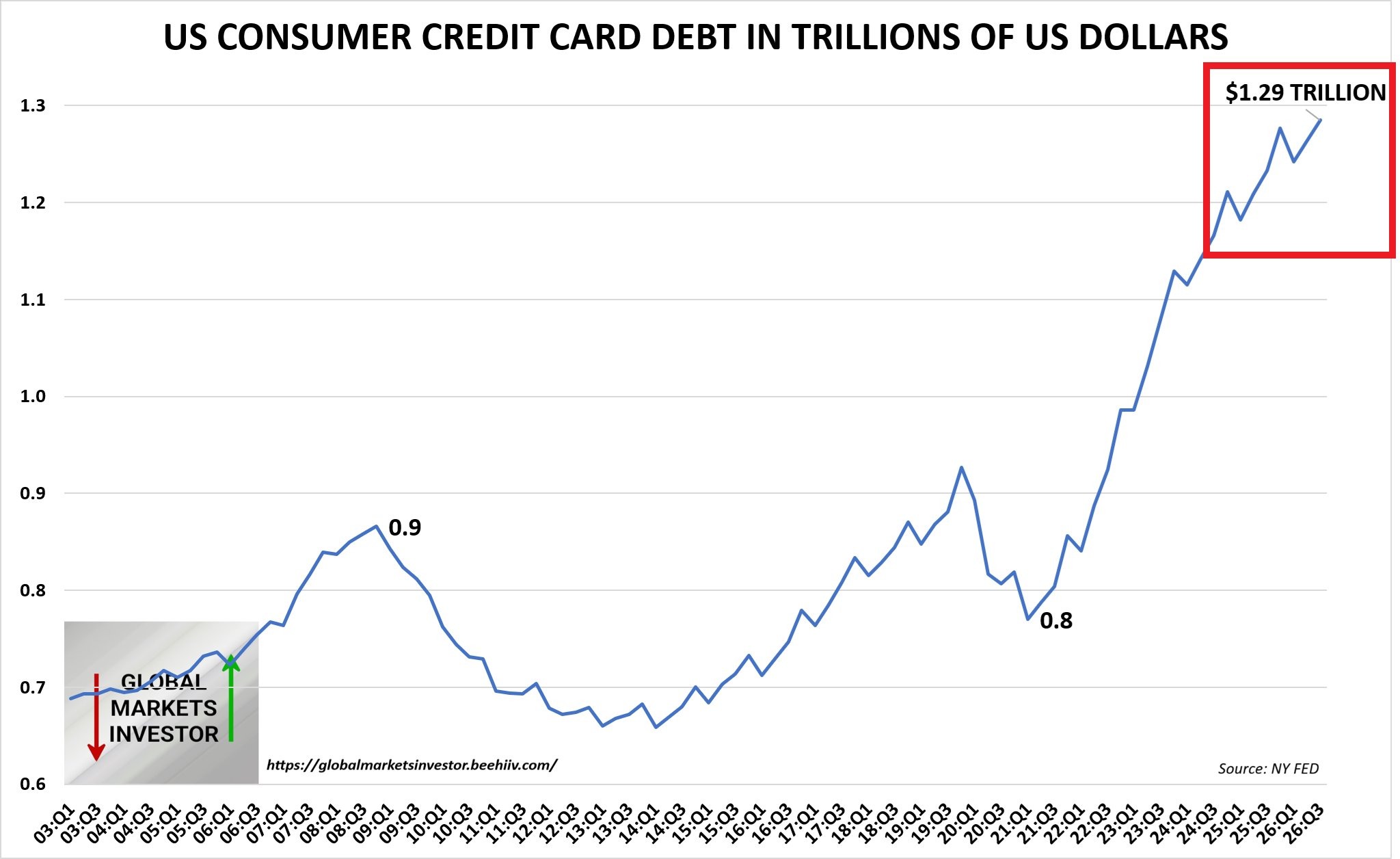
debt. Credit Card debt has reached over $1.2 trillion in the U.S., as shown in the graphic. At the same time, the average interest rate on credit cards is just over 22%.10 That stands in contrast to 1999 and 2007, when credit cards were charging approximately 14% interest.10
Some data would suggest that perhaps U.S. consumers are becoming a stretched with too much debt. While household debt as a percent of disposable personal income remains relatively low, the amount of balances that are becoming delinquent are on the rise.11 Credit card debt that is 90+ days in delinquency is just over 12%, as displayed in the graphic. That is on par with the
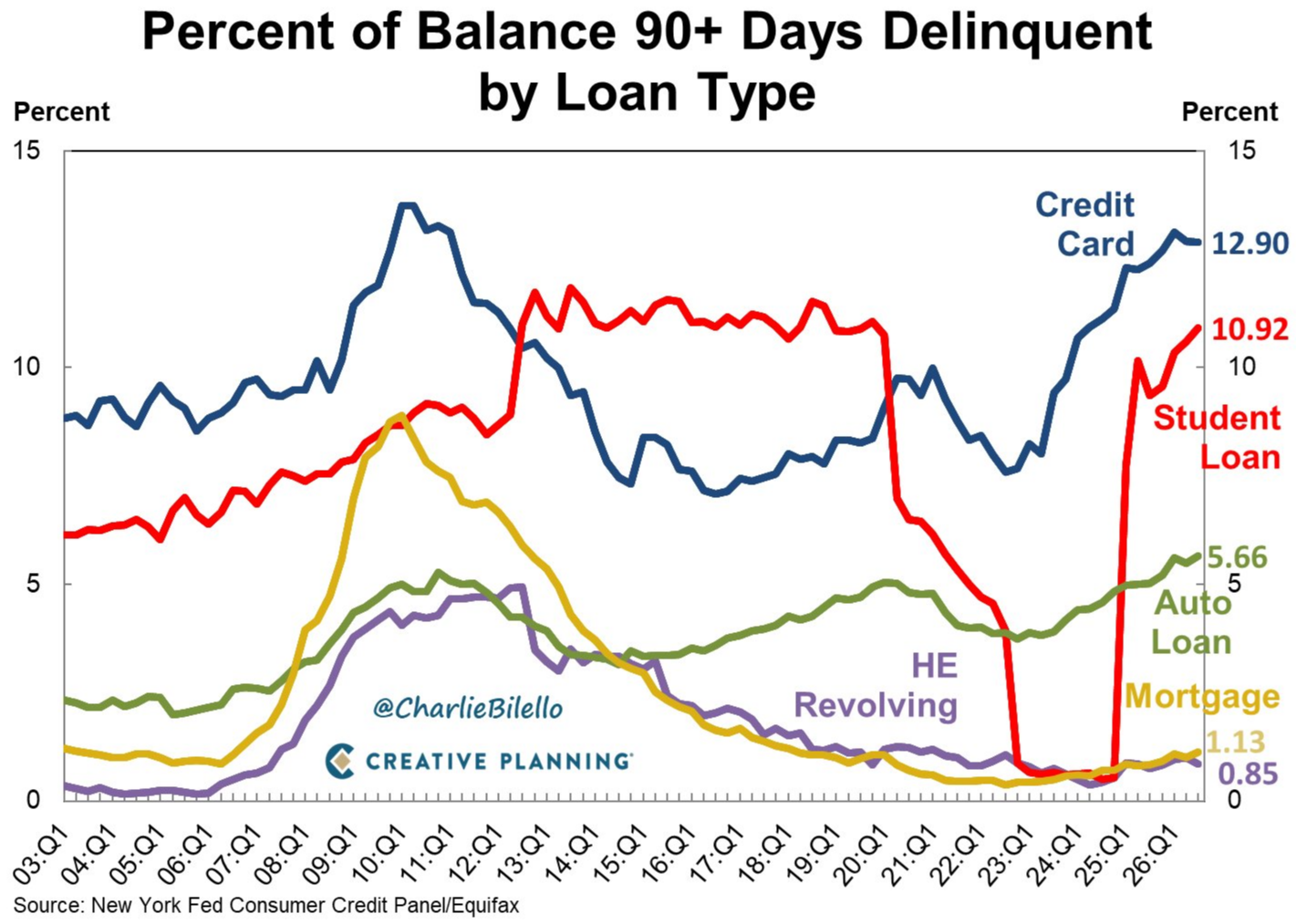
delinquency rate near the end of the 2008 financial crisis. Student loan debt delinquency has been elevated for some time. While Revolving Home Equity and Mortgage delinquency is low, Auto Loan delinquencies are up to over 5%, on par with the 2008 financial crisis. It might be too early to tell if the U.S. consumer is getting tired, but rising delinquency rates is typically not a good sign for future spending.
That Ain't Workin'. Investors should be cognizant of internal biases that could affect the way they invest. Getting emotional about a single security or a particular theme in the markets can be problematic. There are certain behavioral finance terms that describe investor belief systems that are usually visible during changes in a security or theme's trend. One example is "anchoring."
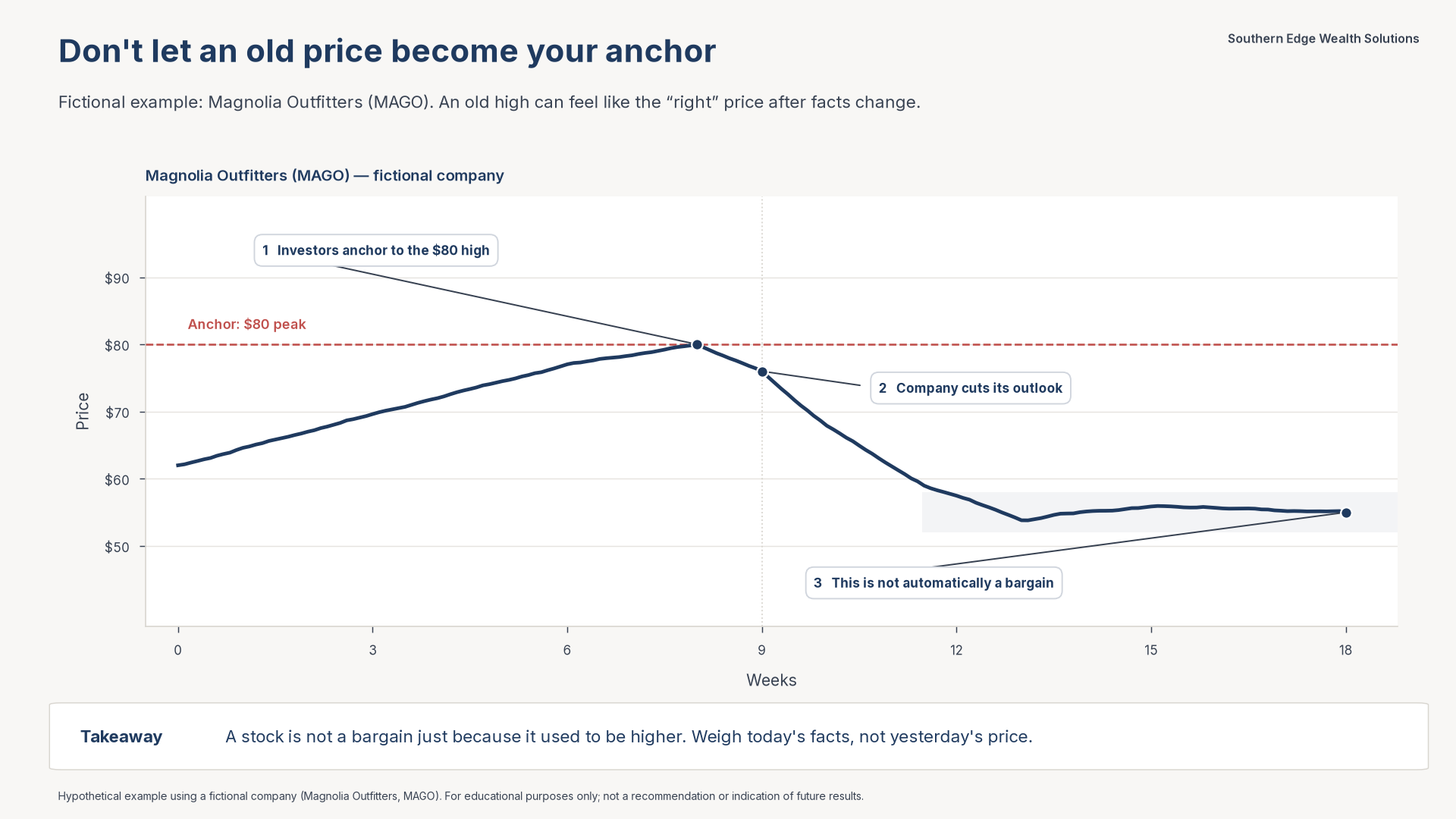
Once a trend takes off, some investors become so enamored with the security or trend that they anchor themselves to the success of that security or trend. An investor can get fixated with a security or the price paid for the security and judge all other decisions against current facts. In the example above, despite the change in trend, an "anchored" investor might refuse to sell the security despite a change in the outlook of said company.
Similar to anchoring, the "loss aversion" belief can be just as costly. Losses can sometimes feel worse that gains feel good. Investors with loss aversion can hold onto a security or basket of securities because they fear losses so much they will hold a security just to get back to even. There are times when a security or theme has shifted to preclude gains for quite some time until the
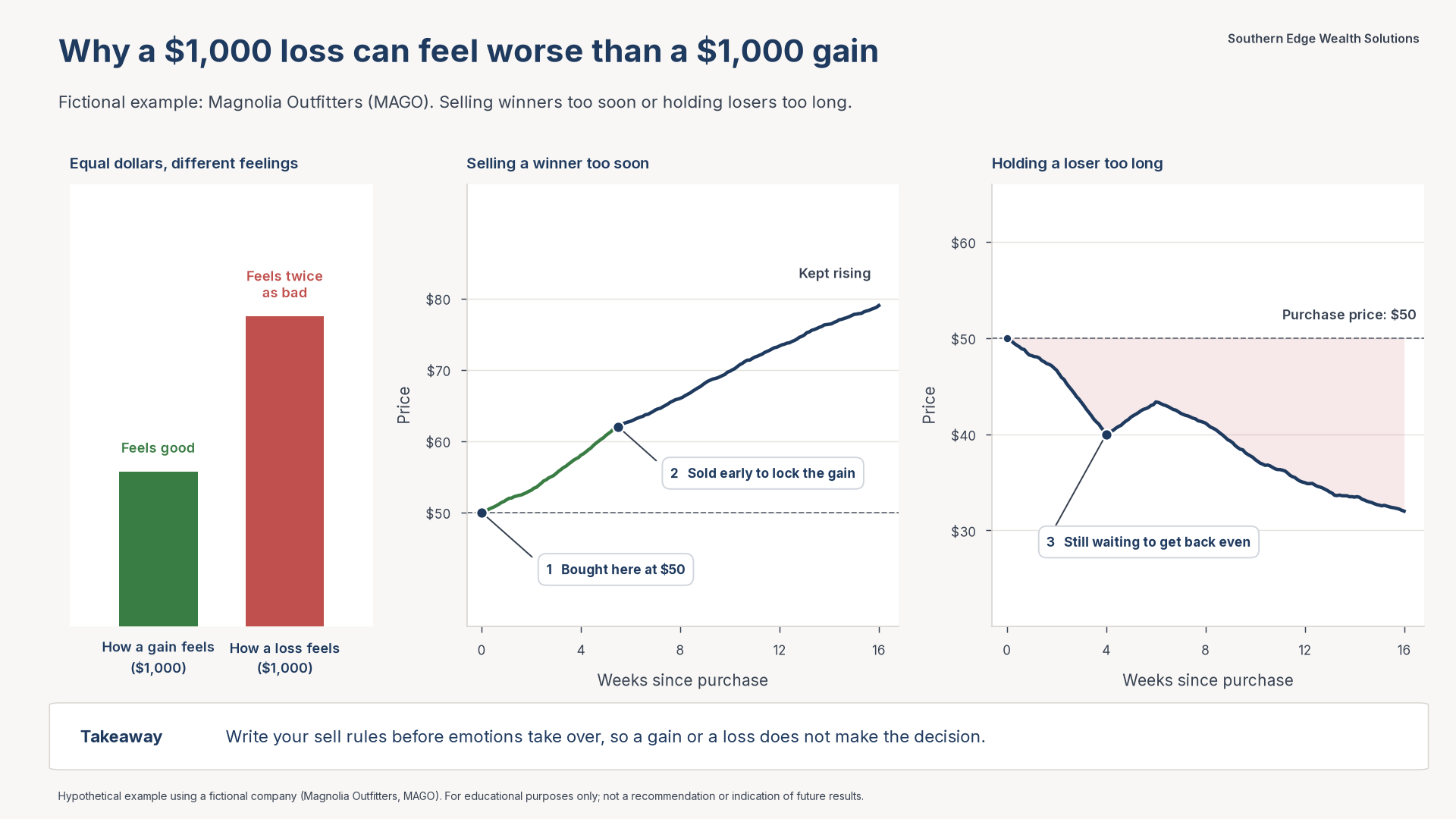
facts present a change that favors a positive trend. Recency bias - recent events feel like a "new normal" - and confirmation bias - looking for news that supports what we believe to be true and tune out anything that challenges said view - can also affect our ability to manage risk in a portfolio. Adopting a solid diversification approach to investing could help mitigate risks, notably when market themes shift.
Click here to a watch the original music video for "Money For Nothing".....
- https://www.investing.com/news/technology-news/nvidia-ceo-huang-steps-down-5021971
- https://rillor.com/insights/gpu-depreciation-and-useful-life
- https://en.fnnews.com/news/202611111610393909
- https://www.investing.com/economic-calendar/cpi-69
- FedWatch - CME Group
- https://www.federalreserve.gov/newsevents/speech/waller20261110a.htm
- https://www.investing.com/economic-calendar/core-cpi-56
- 30-Year Fixed Rate Mortgage Average in the United States (MORTGAGE30US) | FRED | St. Louis Fed
- https://www.investing.com/economic-calendar/redbook-911
- Commercial Bank Interest Rate on Credit Card Plans, Accounts Assessed Interest (TERMCBCCINTNS) | FRED | St. Louis Fed
- Household Debt Service Payments as a Percent of Disposable Personal Income (TDSP) | FRED | St. Louis Fed
_________________________________________________________________________________________
Disclosures
The information contained herein is for informational purposes only and is developed from sources believed to be providing accurate information. The opinions expressed are those of the author, are for general information, and should not be considered a solicitation for the purchase or sale of any security. The decision to review or consider the purchase or sell of any security should not be undertaken without consideration of your personal financial information, investment objectives and risk tolerance with your financial professional.
References to specific securities are for illustrative purposes only and are not recommendations.
Forecasts or forward-looking statements are based on assumptions, may not materialize, and are subject to revision without notice.
Any market indexes discussed are unmanaged, and generally, considered representative of their respective markets. Index performance is not indicative of the past performance of a particular investment. Indexes do not incur management fees, costs, and expenses. Individuals cannot directly invest in unmanaged indexes. The S&P 500 Composite Index is an unmanaged group of securities that are considered to be representative of the stock market in general.
Past Performance does not guarantee future results.